Views Worth Fighting For
The view from Lunch Tree Hill shaped what Rockefeller chose to protect. A century later, the same valley still shapes what leaders decide to fight for.
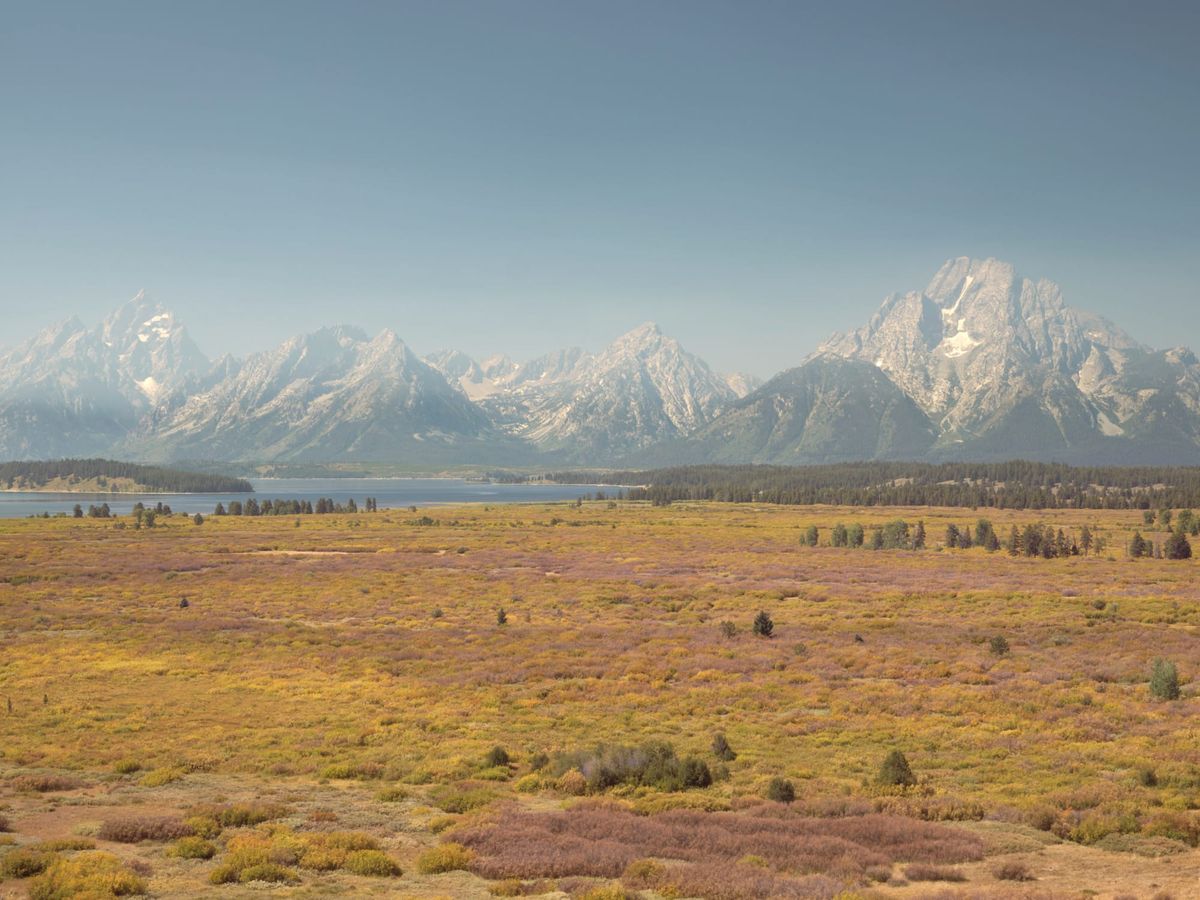
There is a paved half-mile loop that begins behind Jackson Lake Lodge and climbs 110 feet to a flat section above the valley floor. This place is called Lunch Tree Hill, and the photograph above was taken there on a bright, hazy summer day in 2024.
In the summer of 1926, John D. Rockefeller Jr. was twelve days into a family vacation in Yellowstone. Horace Albright, superintendent of Yellowstone National Park, had been explicitly ordered not to discuss his concerns about Jackson Hole's future with Rockefeller. The trip was meant to be a vacation. Albright risked his career anyway by asking Rockefeller if he would like to see the valley to the south. Rockefeller agreed.
At what would become Lunch Tree Hill, the group stopped for a boxed lunch. A plaque, picnic table, and large tree still commemorate the spot to this day. Rockefeller later wrote that the Tetons were "quite the grandest and most spectacular mountains I have ever seen...they present a picture of ever-changing beauty which is to me beyond compare." Standing at elevation, with the full picture of the Cathedral Group visible, something in him shifted. It was the beginning of a view he would spend decades fighting to protect.
As Albright guided the family through the valley over the following days, a second view revealed itself. Telephone lines ran along the rural roads. A rodeo grandstand occupied what had been open land near Jenny Lake. There was a honky-tonk dance hall and a bootleg whiskey joint, the latter noted with particular dismay by Abby Rockefeller. Together they seared an image of what unchecked commercial development would mean for this land. These were not subtle incursions. But from inside the valley's ranching economy, with its growing shift toward seasonal tourism, they were nearly impossible to see for what they were becoming.
By November 1926, those competing views of what Jackson Hole might become were still rooted in Rockefeller's mind when Albright traveled to New York carrying maps and plans. Rockefeller had asked for the maps himself. His awe came at the overlook. His conviction compounded in the months that followed. By 1927 he had formed the Snake River Land Company, operating quietly without his name attached, and committed to purchasing more than 30,000 acres with the intention of donating the entire holding to the federal government.
What followed was not a clean victory. The political opposition was sustained and fierce, ranging from ranchers to Wyoming's congressional delegation to anyone else who held a different view for the valley's future. Grand Teton National Park was established in 1929, but its original boundaries protected only the Teton Range and the glacial lakes at its base. The valley floor remained contested. Not until 1950, twenty-four years after that afternoon on the hill, was the land Rockefeller had purchased incorporated into an expanded park through an act of Congress. The valley in the photograph is the result of a conviction that held for nearly a quarter century.
Decades later, two men in ski clothes met at a health policy conference in Colorado, both heading for the slopes the moment the session broke. One was Paul Ellwood, a Minneapolis physician who had started asking uncomfortable questions about why the American health system rewarded volume over outcomes. The other was Alain Enthoven, an economist who had spent years applying systems analysis to defense procurement at the Pentagon and was turning the same rigor toward health care. He would later become a professor at Stanford. They started talking on the way to the ski lift and never stopped.
The conversation eventually migrated to Jackson Hole. Beginning in the 1970s, Ellwood convened informal gatherings in the valley that went on for decades. The heads of Blue Cross and Blue Shield came. So did the Mayo Clinic, Harvard Community Health Plan, and Kaiser-Permanente. They called Enthoven "the professor." Out of those gatherings, Ellwood, Enthoven, and a small group of colleagues worked out what became managed competition: a framework of competing health plans, purchasing cooperatives, and structured market incentives that shaped how operators built the modern managed care system.
The system you operate inside today began as a conversation in a living room in this valley.
The Jackson Hole Group published its defining work in the early 1990s. The members took significant criticism. They were accused of being captured by entrenched industry interests. They sparred openly with the Clintons and were ultimately left outside the task force that drew on their ideas. The work was done privately. The outputs went public, and the exposure created its own friction. Years later, the exchange architecture at the center of the Affordable Care Act would carry the managed competition principles the group had spent decades developing.
I have spent many years in this valley now. The conversations that have mattered most to me happened in the halls of the Four Seasons and around tables in the village, not in formal sessions. Some of those moments I carry still.
In 2018, I stood with Alain Enthoven in Jackson Hole. He was in his late eighties. Right before dinner, he looked up at the vertical slopes that rise above the restaurants and terraces around the village, and he remarked on what it had been to ski those hills when he was younger. His heart seemed full in that moment. Maybe his head was longing for days of vitality that were behind him now.
The man who helped position the framework your organization operates inside was standing at the base of the mountain where the thinking began, resting on his cane, looking up.
I have never forgotten that image. This place holds that kind of moment. It has held them for a century.
The information environment is different now than it was when Ellwood convened those early gatherings. The things that group could do in the 1970s, 80s, and 90s, meeting informally, thinking out loud, publishing candidly, and absorbing the public scrutiny that followed, carry a different cost for senior executives today. Every room that claims to be private is now a potential broadcast, and that has changed what candor costs. But the desire to be in a place that demands your full attention on the problems that actually matter has not changed at all.
That is why 4mul8 is in Jackson Hole. The lineage is intentional. It's also why our work is fully private. I wanted to build here, with leaders that have different viewpoints, from the first time I saw the Tetons and then read about the work of the Jackson Hole Group. I do not agree with everything they believed. You probably do not either. That is the point of this place: to help each of us find the view we deeply believe in, and then spend the next decade or more fighting for it.
The view from Lunch Tree Hill has not changed because the decision that protected it held. Walk up there and you can take in the whole picture at once, what is magnificent and what is at risk, from the same perch where Rockefeller stood. The challenges of our moment are as present as his were in his.
This valley has held its view for a century. The clearer question is what you will choose to see, and fight for, while you are standing in it.